July 3, 2026 · 10:37 AM
Huberman Lab速读:柔韧性要练,但别把自己拉疼
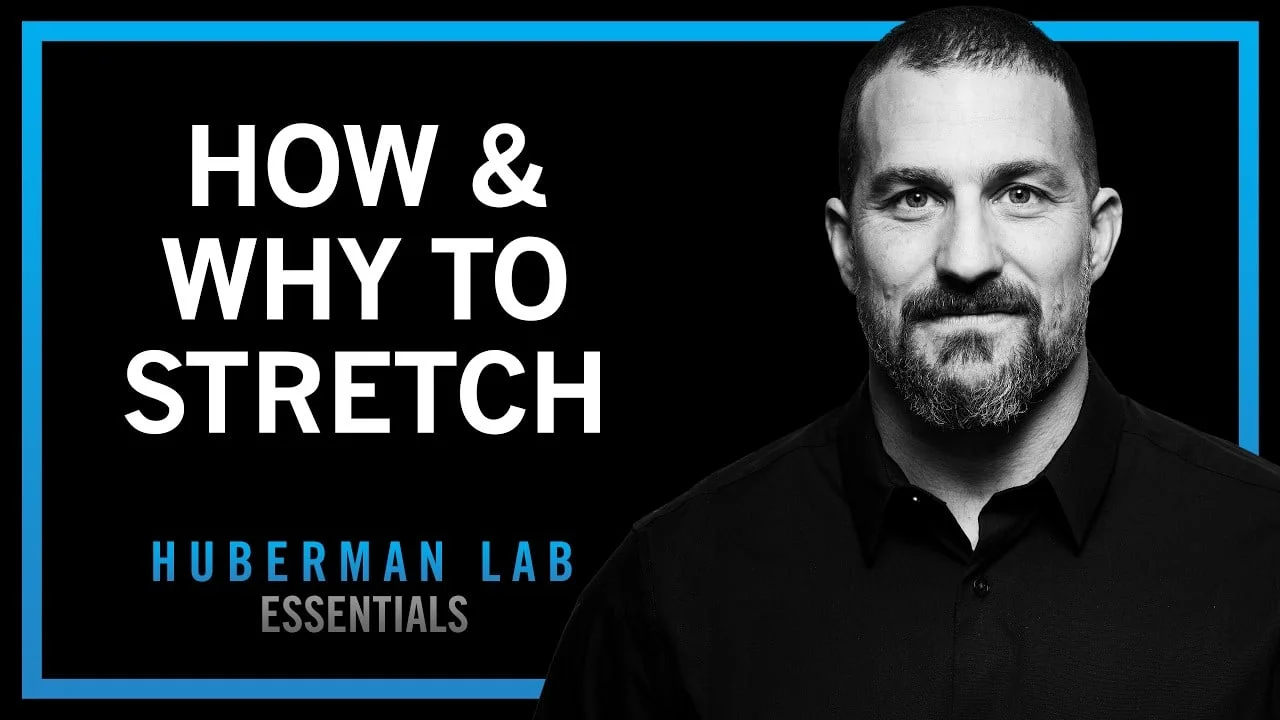
这期速读梳理 Huberman Lab Essentials 关于柔韧性与拉伸的 32 分钟节目:柔韧性不是硬把身体掰开,而是神经系统、肌肉、结缔组织和疼痛感共同调节的结果;文章整理了静态拉伸频率、热身、低强度拉伸、运动前拉伸取舍和瑜伽与疼痛耐受的关键结论。

这期 Huberman Lab Essentials 不是在教一个「拉筋动作大全」,而是在回答一个更基础的问题:为什么同样一个前屈,有人越拉越紧,有人却能慢慢放松进去?Andrew Huberman 把答案拆成神经系统、肌肉、结缔组织和大脑对不适的解释方式:柔韧性训练的关键,不是把疼痛忍过去,而是让身体的保护性警报逐步降低。1
本集信息
- 节目:Huberman Lab Essentials
- 本期标题:Improve Flexibility with Research-Supported Stretching Protocols
- 发布方:Andrew Huberman
- 发布时间:2026 年 6 月 18 日 20:00(北京时间)
- 时长:32 分 16 秒
- 原始视频:https://www.youtube.com/watch?v=syJYZm5OZhE
Loading content card…
先说结论:有效拉伸更像「降警报」,不是硬扛疼痛
Huberman 给出的主线很清楚:柔韧性并不只是肌肉长短的问题。肌肉、肌腱、韧带和关节当然参与其中,但真正决定你能不能进入更大的活动范围的,是神经系统怎么判断「安全」和「危险」。肌梭会感知肌肉被拉长,必要时触发收缩,把肢体拉回它认为安全的范围;高尔基腱器官则监测负荷,负荷过大时会抑制运动神经元,避免肌肉、肌腱或关节被破坏。1
所以,「放松进入拉伸」不是一句玄学口号。它对应的是大脑和脊髓层面的调节:当身体把某个角度解释为可接受的不适,而不是危险信号,保护性反射就可能下降,活动范围才更容易打开。
如果只想带走一个可执行答案:优先做低强度静态拉伸。每个目标肌群每周累计至少 5 分钟;单次可以做 2—4 组,每组保持 30 秒左右;最好每周分散到 5 天左右完成;拉伸前先把身体热起来;强度不要逼近疼痛,低到「有感觉但不挣扎」反而可能更好。1
1. 柔韧性不是一根筋的事:肌梭和高尔基腱器官在守门
Huberman 先把系统拆成三层:神经、肌肉、结缔组织。神经系统通过运动神经元让肌肉收缩;肌肉内部的感受器会把被拉长的信息送回脊髓;肌腱附近的高尔基腱器官则监测负荷。
肌梭可以理解成肌肉里的「长度报警器」。当一个肢体被带到更大的活动范围,肌肉纤维被拉长,肌梭会向脊髓发送信号;如果系统判断拉得太多,运动神经元会被激活,让肌肉收缩,把肢体带回安全范围。高尔基腱器官更像「负荷保险丝」:当你试图搬起明显过重的东西,它可能抑制对应肌肉继续发力,防止肌腱、韧带或关节被撕裂。1
这解释了为什么很多人越急着拉开,身体越顶回去。你以为自己在和「僵硬」对抗,实际上是在不断触发身体的安全系统。
2. 「放松进入拉伸」背后,是岛叶和 von Economo 神经元
节目中最有意思的一段,是 Huberman 从脊髓反射讲到大脑。岛叶负责解释身体内部感觉,尤其是后岛叶会处理疼痛、不适、冷、热、姿势压力等身体信号。Huberman 特别提到 von Economo 神经元:这类大型神经元在人类中较丰富,可能参与把身体不适、目标、动机和自主神经状态整合起来。1
白话说,当你在拉伸中感到不适,大脑并不是只问「疼不疼」,还会问「这个不适有没有意义」「是不是我主动选择的」「有没有必要继续」。如果答案偏向安全、可控、有目标,大脑就可能把状态从警觉或压力,推向更放松的副交感激活。
这也解释了一个训练上的差异:有些拉伸不是靠意志硬顶,而是靠呼吸、注意力和低强度保持,让身体逐渐相信这个角度不是威胁。
3. 四类拉伸:动态、弹振、静态和 PNF,长期变柔韧优先静态
Huberman 把拉伸分成四类:
| 类型 | 核心特征 | 更适合什么场景 |
|---|---|---|
| 动态拉伸 | 有动作、有控制,动量相对少 | 训练前活动关节、唤醒动作模式 |
| 弹振拉伸 | 借助更多摆动或动量,尤其在末端活动范围 | 某些专项热身,但风险更依赖技术和场景 |
| 静态拉伸 | 到达末端范围后保持,尽量减少动量 | 长期提升或维持活动范围 |
| PNF | 结合本体感觉、收缩与放松,常用辅助带、器械或同伴 | 可以用于特定肌群活动范围训练 |
本体感觉这个词听起来复杂,其实就是大脑知道你的四肢在空间里处于什么位置。PNF 拉伸会利用这种位置感和肌肉收缩 / 放松之间的关系,帮助进入新的活动范围。
但如果目标是长期提升肢体活动范围,Huberman 引用的综述结论更偏向静态拉伸:静态拉伸在长期改善 range of motion 上表现更稳定,甚至可能优于弹振和 PNF。这里的重点不是某一个动作,而是足够稳定、足够频繁地在安全末端保持。1
4. 可执行协议:30 秒、每周至少 5 分钟、低强度
节目给出的协议可以直接落到训练表里:
- 每个目标肌群做静态保持。
- 每组保持约 30 秒。
- 每次可以做 2—4 组。
- 每个肌群每周累计至少 5 分钟。
- 更理想的是分散到一周 5 天左右,而不是偶尔一次拉很久。
- 如果没有先运动,拉伸前用 5—10 分钟轻松有氧或徒手动作把核心体温拉起来。
举例:如果你想改善腘绳肌,可以做 3 组静态拉伸,每组 30 秒,中间休息;这一次只有 90 秒,但如果一周做 5 天,就已经接近 7 分半钟,超过了节目中强调的每周 5 分钟门槛。1
强度上,节目特别强调低强度。Huberman 讨论了一项舞者下肢活动范围研究:研究把 100% 定义为疼痛点,低强度组只做到 30%—40%,中等强度组做到 80%;6 周后,低强度静态拉伸对下肢活动范围的改善更好。换句话说,拉伸不需要追求「快疼到受不了」。如果你把疼痛点当作 100%,更值得尝试的是 30%—40% 那种能放松保持的强度。1
5. 运动前到底要不要拉伸?答案不是一刀切
Huberman 对运动前拉伸的态度很谨慎:静态拉伸放在跑步、力量训练或高表现活动之前,可能在一些情况下压低表现;但如果某个关节或肌群紧到影响动作安全和标准,训练前做一点静态拉伸反而有意义。比如因为活动范围不足导致深蹲姿势危险,先拉开一点,让动作能安全完成,可能比追求当次最大力量更重要。1
更通用的做法是:训练前更偏动态或专项热身;静态拉伸更适合放在训练后,或者放在单独的柔韧性训练时段。这里的判断标准不是「静态拉伸永远好 / 永远坏」,而是它服务的是当下表现,还是长期活动范围。
6. 瑜伽为什么不只是拉伸:它可能在训练你处理不适
节目最后回到岛叶。Huberman 引用一篇关于瑜伽练习者的研究:研究者用冷热刺激测试疼痛耐受,并观察脑结构;结果显示,瑜伽练习者的疼痛耐受达到非练习者的两倍或更多,同时岛叶灰质体积也显著增加。1
这并不是说每个人都必须练瑜伽,也不是鼓励把自己推到危险姿势里。更稳妥的理解是:瑜伽把姿势、呼吸、注意力和不适感放在一起训练,它不只是让肌肉和关节活动范围变大,也可能改变人对疼痛、冷、姿势压力等内感受挑战的解释方式。
这和前面的低强度拉伸并不矛盾:如果目标是柔韧性,低强度更有效、更安全;如果目标还包括压力管理、疼痛耐受和身体觉察,瑜伽这类练习可能提供的是另一层神经系统训练。
这期适合怎么用
如果你只是想「知道怎么拉」,记住三个数字就够了:30 秒保持、每周至少 5 分钟、强度控制在远低于疼痛点的位置。
如果你经常拉伸但没有进步,这期更值得听的是机制部分:你的身体不是被动橡皮筋,而是有一套会自动保护你的神经回路。训练柔韧性,某种意义上是在反复告诉这套回路:这个角度安全,这种不适可控,不需要马上拉响警报。
如果你正在康复、有伤病史,或者某个动作会引发尖锐疼痛,这期不能替代专业评估;更适合把它当作理解原则的地图,再和医生、物理治疗师或教练一起决定具体动作。
完整逐字转录稿
说明:本节基于公开视频完整字幕整理。原视频为英语节目,因此每个 10 分钟区间先保留英文原文,再附中文字幕译文;本期公开视频字幕未提供可靠多说话人分轨,以下统一标注为 Andrew Huberman。
00:00:00—00:10:00
Andrew Huberman(英文原文):
Welcome to Huberman Lab Essentials, >> [music] >> where we revisit past episodes for the most potent and actionable science-based tools for mental health, physical health, and performance. I'm Andrew Huberman and I'm a professor of neurobiology and ophthalmology at Stanford School of Medicine. Today we are going to discuss the science and practice of flexibility and stretching. The important thing that I'd like you to know is that flexibility and the process of stretching and getting more flexible involves three major components. Neural, meaning of the nervous system, muscular, muscles, and connective tissue. Connective tissue is the stuff that surrounds the neural stuff and the muscular stuff, although it's all kind of weave together and braided together in complicated ways. So, here's a key thing that everyone should know, whether or not you're talking about flexibility or not. Your nervous system controls your muscles. It's what gets your muscles to contract. So, within your spinal cord you have a category of neurons, nerve cells, that are called motor neurons. Those neurons release a chemical. That chemical is called acetylcholine. The release of acetylcholine from these nerve cells, these neurons, onto the muscles causes the muscles to contract. And when muscles contract, they are able to move limbs by way of changing the length of the muscle, adjusting the function of connective tissue like tendons and ligaments. Now, within the muscles themselves, there are nerve connections. And these are nerve connections that arise from a different set of neurons in the spinal cord that we call sensory neurons. These spindle connections within the muscle that wrap around the muscle fibers sense the stretch of those muscle fibers. So, now we have two parts to the system that I've described. You've got motor neurons that can cause muscles to contract and shorten, and we have these spindles within the muscles themselves that wrap around the muscle fibers, and that information is sent from the muscle back to the spinal cord. It's a form of sensing what's going on in the muscle. Now, why would that be useful? Well, what this does is it creates a situation where if a muscle is or is stretching too much because the range of motion of a limb is increased too much, then the muscle will contract to bring that limb range of motion into a a safe range again. Okay, so just to clarify, this whole thing looks like a loop, and the essential components of the loop are motor neurons contract muscles, sensory neurons that we call spindles are sensing stretch within the muscles, and if a given muscle is elongating because of the increased range of motion of a limb, those sensory neurons send an electrical signal into the spinal cord such that there is an activation of the motor neuron, which by now should make perfect sense as to why that's useful. It then shortens up the muscle. It actually doesn't really shorten the muscle, but contracts the muscle. It brings the limb back into a safe range of motion. So, that's one basic mechanism that we want to hold in mind. This idea of a spindle that senses stretch and can activate contraction of the muscles and shorten the muscles. The next mechanism I want to describe, and once again, there are only two that you need to hold in mind for this episode, has to do with sensing loads. So, at the end of each muscles, you have tendons typically, and there are neurons that are closely associated with those tendons that are called Golgi tendon organs, right? These are neurons that are sensory neurons that sense how much load is on a given muscle, right? So, if you're lifting up something very, very heavy, these neurons are going to fire, meaning they're going to send electrical activity into the spinal cord, and then those neurons have the ability to shut down, not activate, but shut down motor neurons and to prevent the contraction of a given muscle. So, for instance, if you were to walk over and try and pick up a weight that is much too heavy for you, meaning you could not do it without injuring yourself. There are a number of reasons why you might not be able to lift it, but let's say you start to get it a little bit off the ground or you start to get some force generated that would allow it to move. But, the force that you're generating could potentially rip your muscles or your tendons off of the bone, right? That it could disrupt the joints, that could tear ligaments. Well, you have a safety mechanism in place. It's these Golgi tendon organs, these GTOs as they're called, that get activated and shut down the motor neurons and make it impossible for those muscles to contract. There are also mechanisms that arrive to the neuromuscular system from higher up in the nervous system, from the brain. And those mechanisms involve a couple of different facets that are really interesting and I think that we should all know about. In fact, today I'm going to teach you about a set of neurons that I'm guessing 99.9% of you have never heard of, including all you neuroscientists out there, if you're out there. And I know you're out there. That seem uniquely enriched in humans and probably perform essential roles in our ability to regulate our physiology and our emotional state. So, within the brain we have the ability to sense things in the external world, something we called exteroception, and we have the ability to sense things in our internal world, within our body, called interoception. Interoception can be the volume of food in your gut, whether or not you're experiencing any organ pain or discomfort, whether or not you feel good in your gut and in your organs. The main brain area that's associated with interpreting what's going on in our body is called the insula, i n s u l a. It's a very interesting brain region. It's got two major parts. The front of it is mainly concerned with things like smell and to some extent vision. Like if you smell something good to approach it or if you smell something bad to avoid it. The posterior insula, the back of the insula that is, has a very interesting and distinct set of functions. The posterior insula is mainly concerned with what's going on with your somatic experience. How do you feel internally? It mainly batches information into yum, I want to keep doing this or approach this thing, or continue down some path of movement or eating or staying in a temperature environment, etc. Or yuck, I need to get out of here. I don't want any more of this. I don't want to keep doing this. This is painful or aversive or stressful. In your posterior insula, you have a very interesting population of very large neurons. These are exceptionally large neurons called von Economo neurons. Neurons that are again, unbeknownst to most neuroscientists, and they seem uniquely enriched in humans. Why is that interesting? Well, these von Economo neurons have the unique property of integrating our knowledge about our body movements, our sense of pain and discomfort, and can drive motivational processes that allow us to lean into discomfort and indeed to overcome any discomfort if we decide that the discomfort that we are experiencing is good for us or directed toward a specific specific goal. And then, there's the other really interesting aspect of these von Economo neurons, which is that these von Economo neurons are connected to a number of different brain areas that can shift our internal state from one of so-called sympathetic activation. So, this is a pattern of alertness and even stress, sometimes even panic, but typically alertness stress, to one of so-called parasympathetic activation. To one of relaxation. Oftentimes you'll hear that stretching should be done by relaxing into the stretch. Well, what does it actually mean to relax into the stretch? Well, these von Economo neurons sit at this junction where they're able to evaluate what's going on inside our body and allow us to access neural circuitries by which we can shift our relative level of alertness down a bit or our relative level of stress down a bit and thereby to increase so-called parasympathetic activation and to literally override some of those spindle mechanisms, even the GTO mechanisms, but especially the spindle mechanisms at the neuromuscular and muscular spinal junction. I'll give you a brief example of this that you've already done in your life and that we all have the capacity for. What I'm referring to is the monosynaptic stretch reflex. This is something that every first-year neuroscience graduate student learns, which is that if you were to step on a sharp object with a bare foot, you would not need to make the decision to retract your foot. You would automatically do that, provided you have a healthy nervous system. There are mechanisms in place that cause the retraction of that limb by way of ensuring that the proper muscles contract and other muscles do not contract, in fact, that they fully relax. Okay? So, in the case of stepping on a sharp object like a piece of glass or a nail or a tack, you would essentially activate the hip flexor to lift up your foot as quickly as possible. In doing so, that same neural circuit would activate a contralateral, meaning opposite side of the body, circuit to ensure that the leg, the foot that's not stepping on the sharp object, would do exactly the opposite and would extend to make sure that you don't fall over. All of that happens reflexively. It does not require any thought or decision-making. However, if your life depended on walking across some sharp objects, let's say let's make it a little less dramatic so it's not like the Die Hard movie or something where you have to run barefoot across the glass, although that's a pretty good example of what I'm describing here. But let's say you had to walk across some very hot stones to get away from
Andrew Huberman(中文译文):
欢迎来到 Huberman Lab Essentials, [音乐] 在这里,我们将回顾过去的节目,寻找 最有效、最实用的基于科学的 心理健康、身体 健康和表现工具。 我是安德鲁·胡伯曼,斯坦福大学医学院 神经生物学和眼科学教授 。 今天我们 将探讨 柔韧性和拉伸的科学原理和实践方法。 我想让你们知道的重要一点 是,柔韧性以及 拉伸和提高柔韧性的过程 包含三个主要组成部分。 神经的, 指神经系统;肌肉的, 指肌肉;结缔组织。 结缔组织是 围绕神经组织和 肌肉组织的物质,尽管它们 以复杂的方式交织在一起。 所以, 无论你是否在谈论灵活性,这里有一个每个人都应该知道的关键点 。 你的神经系统控制你的 肌肉。 它能使你的肌肉 收缩。 所以,在你的脊髓中, 有一类神经元,也就是神经 细胞,被称为运动神经元。 这些神经元会释放一种化学物质。 这种 化学物质叫做乙酰胆碱。 这些 神经细胞(神经元)释放乙酰胆碱到肌肉上, 引起肌肉收缩。 当肌肉收缩时,它们可以 通过改变肌肉的长度来移动肢体 ,从而调整 肌腱和韧带等结缔组织的功能 。 肌肉内部也 存在神经连接。 这些神经连接 源自脊髓中另一组神经元, 我们称之为感觉 神经元。 肌肉内的这些梭形连接 包裹着肌纤维,能够感知 肌纤维的拉伸。 所以,现在我们有了 我所描述的系统的两个部分。 人体内存在运动 神经元,它们可以使肌肉 收缩和缩短; 肌肉内部还有肌梭,它们 包裹着肌纤维,并将 信息从肌肉传递 回脊髓。 这是一种 感知肌肉内部状况的方式。 那么,这样做有什么用呢? 这样 做会产生这样一种情况: 如果由于肢体活动范围过大而导致肌肉过度拉伸 ,那么 肌肉就会收缩,使肢体的 活动范围再次回到安全范围内 。 好的,为了更清楚地说明, 整个过程看起来像一个循环,这个 循环的基本组成部分是: 运动神经元使肌肉收缩; 我们称之为肌梭的感觉神经元 感知肌肉内的拉伸; 如果某个肌肉由于 肢体活动范围的增加而伸长, 这些感觉神经元就会 向脊髓发送电信号,从而 激活运动 神经元。现在你应该完全 明白为什么这样做有用了吧。 然后它会使 肌肉缩短。 它实际上并 不会真正缩短肌肉,而是 收缩肌肉。 它能使肢体 恢复到安全的活动范围。 所以, 这是我们需要牢记的一个基本机制 。 这种纺锤体能够 感知拉伸,并能激活 肌肉收缩和缩短 肌肉。 接下来我要 描述的机制,同样, 在本集中你只需要记住两个,与感知 负载有关。 所以,每块肌肉的末端 通常都有肌腱,而 与这些肌腱紧密相关的神经元 被称为高尔基腱器官, 对吧? 这些是 感觉神经元,它们能感知 特定肌肉所承受的负荷,对吗? 所以,如果 你举起非常非常 重的东西,这些神经元就会放电,这 意味着它们会将电 活动传递到脊髓, 然后这些神经元能够 关闭(不是激活),而是关闭 运动神经元,从而阻止 特定肌肉的收缩。 例如 ,如果你走过去 试图拿起 一个 对你来说太重的物体,这意味着你如果 不伤害自己就无法拿起它 。 有很多原因可能 导致你无法将其举起, 但假设你开始将其 稍微抬离地面,或者你开始 产生一些力,使它能够 移动。 但是,你产生的力道 可能会将你的肌肉或 肌腱从骨头上撕裂下来,对吧? 它可能会损伤关节,甚至 撕裂韧带。 嗯,你们有 安全机制。 正是这些 高尔基腱器官(GTO)被 激活, 关闭运动神经元,使 这些肌肉无法 收缩。 还有一些机制是 从 神经系统更高层(即 大脑)传递到神经肌肉系统的。 这些机制涉及几个 非常有趣的不同方面, 我认为我们都应该了解 。 事实上,今天我要教 大家了解一组神经元,我 猜想 99.9%的 人都没听说过,包括 你们这些神经科学家(如果 你们在的话)。 我知道你们就在那里。 这些物质似乎在人类身上特别丰富, 并且可能在 我们调节生理 和情绪状态的能力中发挥着至关重要的作用。 因此, 我们的大脑能够感知 外部世界的事物, 我们称之为外感受;我们也能够 感知内部 世界,也就是我们身体内部的事物,这被称为 内感受。 内感受可以是 肠道内食物的量,无论 你是否感到任何器官疼痛 或不适,无论 你的肠道和器官感觉如何。 大脑中负责 解读我们身体正在发生的事情的主要区域 叫做岛叶(insula)。 这是 大脑中一个非常有趣的区域。 它由 两部分组成。 它的前端 主要 负责嗅觉,并在 一定程度上负责视觉。 就像闻到 好东西就靠近, 闻到坏东西就避开一样。 后岛叶,也就是岛叶的后部, 具有一系列非常有趣且独特的 功能。 后岛叶主要 与你的躯体 体验有关。 你内心感觉如何? 它主要将信息批量处理,比如“好吃”, 我想继续做这件事,或者接近 这件事, 或者继续沿着某种路线移动, 或者吃东西,或者待在某种温度 环境中等等。或者“真恶心”,我需要 离开这里。 我不想再经历这一切了 。 我不想继续这样做了。 这令人痛苦、厌恶或 压力巨大。 你的后脑岛中 存在着一群非常有趣的 大型神经元。 这些是 异常大的神经元,称为冯· 埃科诺莫神经元。 而 大多数神经科学家对此却一无所知,而且 这些神经元似乎在人类身上特别丰富。 为什么这很有趣? 这些冯· 埃科诺莫神经元具有独特的特性,能够 整合我们 对身体运动、 疼痛和不适感的认知,并 能驱动动机过程,使 我们能够正视不适, 如果我们 认为正在 经历的不适对我们有益或指向 某个特定的目标,我们就能克服任何不适。 此外, 冯·埃科诺莫 神经元还有另一个非常有趣的方面,那就是这些冯·埃科诺莫 神经元与许多 不同的脑区相连,这些脑区 可以将我们的内部状态从 所谓的交感神经激活状态转变为其他状态。 所以,这是一种警觉 甚至紧张,有时甚至是恐慌的模式,但 通常是警觉紧张,是 所谓的副交感神经激活。 放松一下。 你经常会 听到这样的说法:拉伸应该通过 放松身体来完成。 那么, 放松地伸展到底意味着什么呢 ? 这些冯·埃科诺莫神经元 位于这个交界处,它们能够 评估我们 身体内部正在发生的事情,并使我们能够进入神经 回路,从而 稍微降低我们的相对警觉水平 或相对压力水平, 进而增加所谓的副 交感神经激活,并 实际上抑制一些纺锤体 机制,甚至是高尔基腱器官机制, 特别是 神经肌肉和肌肉脊髓 交界处的纺锤体机制。 我举一个 你在生活中已经做过, 而且我们每个人都有能力做到的例子 。 我指的是 单突触牵张反射。 这是每个 神经科学专业一年级研究生都会学到的东西, 那就是,如果你 赤脚踩到尖锐的物体,你 不需要决定是否缩回 你的脚。 只要神经系统健康,你就会自然而然地这样做 。 人体内存在一些机制, 通过确保适当的 肌肉收缩而其他肌肉 不收缩(实际上,是完全 放松),从而使肢体回缩。 好的? 因此,如果 踩到玻璃碎片 、钉子或图钉等尖锐物体,你 基本上会激活髋屈肌, 尽快抬起脚 。 这样一来 ,同样的神经回路 就会激活对侧(即 身体的另一侧)回路,以 确保没有 踩到尖锐物体的腿(脚)会做出 完全相反的动作,伸展身体以防止 你摔倒。 这一切都是 下意识发生的。 它不需要 任何思考或决定。 但是, 如果你的生命取决于走过 一些尖锐的物体,那么我们不妨把 它描述得不那么戏剧化,不要 像《虎胆龙威》电影里那样, 你必须赤脚跑过 玻璃,尽管那确实是 我在这里描述情况的一个很好的例子。 但 假设你必须走过一些 非常滚烫的石头才能躲开
00:10:00—00:20:00
Andrew Huberman(英文原文):
something that you wanted to avoid, you could override that stretch reflex by way of a decision made with your upper motor neurons, your insula, and your cognition, and almost certainly those van Economo neurons, which would be screaming, "Don't do this. Don't do this. Don't do this." could shuttle that information to brain areas that would allow you to override the reflex and essentially push through the pain. And maybe even, in fact, even not experience the pain to the same degree or even at all. So, these van Economo neurons sit at a very important junction within the brain. They pay attention to what's going on in your body, pain, pleasure, etc. And that includes what's going on with your limbs and your limb range of motion. They also are paying attention and can control the amount of activation, kind of alertness or calmness that you are able to create within your body in response to a given sensory experience. And as I mentioned before, they seem to be uniquely enriched in humans. They seem to be related to the aspects of our evolution that allow us to make decisions about what to do with our body in ways that other animals just simply can't. Now, there are a number of different types of stretching or methods of stretching. Broadly defined, we can describe these as dynamic, ballistic, static, and what's called PNF stretching. PNF stands for proprioceptive neuromuscular facilitation. The first two that I mentioned, dynamic and ballistic stretching, both involve some degree of momentum and can be distinguished from static and PNF type stretching. Now, to distinguish dynamic stretching from ballistic stretching, I'd like to focus on this element of momentum. Both involve moving a limb through a given range of motion. In dynamic stretching, however, it tends to be more controlled, less use of momentum, especially towards the end range of motion. Whereas in ballistic stretch there tends to be a bit more swinging of the limb or use of momentum. But again, dynamic and ballistic stretching both involve movement, so we have to generate some force in order to create that movement. Ballistic stretching involving a bit more momentum or sometimes a lot more momentum, especially at the end range of of motion. Now, both of those are highly distinct from static stretching, which involves holding the end range of motion, so minimizing the amount of momentum that's used. Static stretching can be further subdivided into active or passive, right? There are different names for these kinds of approaches. You can hear about the Anderson approach or the Janda approach. You can look these sorts of things up online. There's also passive static stretching, in which it's more of a relaxation into a further range of motion, and that can be a subtle distinction. Nevertheless, static stretching involves both those types of elements, active and passive, but is really about eliminating momentum. And then there's the PNF, the proprioceptive neuromuscular facilitation. And proprioception has several different meanings in the context of neuroscience and physiology. To just keep it really simple for today, proprioception involves both a knowledge and understanding of where our limbs are in space and relative to our body, typically relative to the midline. So, the brain is often trying to figure out where are our limbs relative to our midline down the center of our body. And if your goal is to increase your hamstring flexibility and the flexibility and range of motion of other related muscle systems, you might put a strap around your ankle and pull that muscle, or I should say, excuse me, that limb toward you. You're not going to pull the muscle toward you. You're going to pull that limb, your ankle, toward you to try and get it sort of back over your head, and then progressively relaxing into that, or maybe even putting some additional force to push the end range of motion, and then relaxing it, and then actually trying to stretch that same limb or increase the limb range of motion without the strap. There's a huge range of PNF protocols. Those protocols can be done both by oneself, with or without straps, with machines, with actual weights, or with training partners. So, specific exercises to target specific muscle groups aside, we've now established that there are four major categories of stretching, or at least those are the four major categories I'm defining today. But in terms of increasing limb range of motion in the long term, of truly becoming more flexible, as opposed to transiently more flexible, static stretching, which includes PNF, appears to be the best route to go. So, whether or not you want to maintain, reestablish, or gain limb range of motion, static stretching of holds of 30 seconds appear to be best. Now, the question is, how long should you do that, and how many sets should you do that, and how many times a week should you do that? To answer those questions, I'm going to turn to what I think is a really spectacular review. The title of the paper is "The Relation Between Stretching Typology and Stretching Duration: The Effects on Range of Motion." First of all, and I quote, "All stretching typologies showed range of motion improvements over a long-term period. However, the static protocols showed significant gains with a P value less than 0.05, which means a probability that cannot be explained by chance alone, when compared to ballistic or PNF protocols." So, again, what we're hearing is that static stretching is the preferred mode for increasing limb range of motion. Although, here they make the additional point that static stretching might even be superior not just to ballistic stretching, but also to PNF protocols. The authors go on to say time spent stretching per week seems fundamental to elicit range of movement improvements when stretches are applied for at least or more than 5 minutes per week. Okay, this is critical. This is not 5 minutes per stretch. Remember, 30 seconds per static stretch, but at least 5 minutes per week. So, what this means is that we should probably be doing anywhere from two to four sets of 30-second static hold stretches 5 days per week. So, what would effective stretching protocol look like? We're all trying to improve limb range of motion for different limbs and different muscle groups. Let's talk about hamstrings for the time being. This could, of course, be applied to other muscle groups. Let's say you want to improve hamstring flexibility and limb range of motion about and around the hamstring. And involving the hamstring, you would want to do three sets of static stretching for the hamstring. You would do that by holding the stretch for 30 seconds, resting some period of time, then doing it again, holding for 30 seconds, resting some period of time, and then holding it for 30 seconds. That would be one training session for the hamstrings. I have to imagine that you'd probably want to stretch other muscle groups as well in that same session. So, three sets of 30 seconds each, get 90 seconds, and you would do that ideally five times a week, or maybe even more. One thing that did show up in my exploration of the peer-reviewed research is this notion of warming up for all this. We haven't talked about that yet. In general, to avoid injury, it's a good idea to raise your core body temperature a bit before doing these kinds of stretches, even these static stretches, which can sort of ease into and don't involve ballistic movement by definition. And the basic takeaway that I was able to find was that if we are already warm from running or from weight training or from some other activity, that doing the static stretching practice at the end of that weight training or cardiovascular or other physical session would allow us to go immediately into the stretching session. Because we're already warm, so to speak. Otherwise, raising one's core body temperature by a bit by doing 5 to 7, maybe even 10 minutes of easy cardiovascular exercise or calisthenic movements, provided you can do those without getting injured, seems to be an ideal way to warm up the body for stretching. We should be warm or warm up to stretch, although those warm-ups don't have to be extremely extensive. And then just by way of logic, doing the static stretching after resistance training or cardiovascular training seems to be most beneficial. In fact, and unfortunately, we don't have time to go into this in too much detail today. I was able to find a number of papers that make the argument that static stretching prior to cardiovascular training, and maybe even prior to resistance training, can limit our performance in running and resistance training. I realize that's a controversial area. You have those who say, "No, it's immensely beneficial." You have those who say, "No, it inhibits performance." And the those that say, "No, it's a matter of how exactly you perform that static stretching and which muscle groups and how you're doing this and how much time in between static stretching and performance." But to leave all that aside, doing static stretching after some other form of exercise, and if you not after some form of exercise, after a brief warm-up to raise your core body temperature, definitely seems like the right way to go. I'm guessing that most people are not doing 5 days a week of dedicated static stretch range of motion directed training. But it does appear that that frequency about the week, getting those repeated sessions even if they are short for an individual muscle group, turns out to be important. They're going to offset the age-related losses in flexibility for sure if one is dedicated about these practices. Some of you may be familiar with the so-called Anderson method. It's been around for a long time. Anderson has an interesting idea and principle which is thread through a lot of his teachings that I think are very much in keeping with the study that I'm about to describe next where he emphasizes to yes to stretch to the end of the range of motion, but not to focus so much on where that range of motion happens to be that day. So for instance, not thinking, "Oh, I can always touch my toes for instance, and therefore that's the starting place for
Andrew Huberman(中文译文):
你想避开的东西,你 可以 通过上 运动神经元、岛叶和 认知能力做出的决定来抑制这种牵张反射,几乎可以肯定的是, 范埃科诺莫神经元也会发出这样的 声音:“不要这样做。不要这样做。 不要这样做。” 可以将这些 信息传递到大脑的特定区域, 使你能够抑制这种反射, 从而克服疼痛。 甚至可能 根本 不会感受到同样的疼痛, 或者完全感受不到疼痛。 因此,这些范埃科诺莫神经元 位于大脑中一个非常重要的交汇点 。 他们会关注 你身体的状况,比如疼痛、愉悦 等等。这其中也包括 你的四肢状况以及四肢的 活动范围。 它们还会留意 并控制你对特定感官体验在体内产生的 激活程度、警觉性或 平静程度 。 正如我之前提到的,它们 在人类身上似乎特别丰富。 它们 似乎与我们 进化过程中使我们能够以 其他动物根本 无法做到的方式决定如何处置自己的身体有关。 现在, 拉伸的类型或方法有很多种 。 广义上讲, 我们可以将这些拉伸方式描述为动态拉伸、 弹道拉伸、静态拉伸以及所谓的 PNF 拉伸。 PNF 代表 本体感觉神经肌肉 促进法。 我 提到的前两种拉伸方式,动态拉伸和弹道拉伸 ,都涉及一定程度的 动量,可以与 静态拉伸和 PNF 型拉伸区分开来。 现在,为了区分动态拉伸 和弹道拉伸, 我想重点谈谈动量这个因素 。 两者都涉及肢体在 特定范围内的运动。 然而,在动态拉伸中,动作 往往更受控制,较少利用 动量,尤其是在 运动范围的末端。 而弹道 拉伸中,肢体往往会有更多的 摆动 或利用动量。 但是,动态拉伸 和弹道拉伸都涉及 运动,所以我们必须产生一些 力量才能产生这种运动。 弹道拉伸涉及 更大的动量,有时甚至需要更大的 动量,尤其是在运动的末端范围 。 这两种方法都 与静态拉伸截然不同,静态拉伸是 指保持运动的末端范围 ,从而最大限度地减少 所使用的动量。 静态拉伸还 可以进一步细分为主动拉伸和 被动拉伸,对吗? 这类方法有不同的 名称。 你 可以听说过安德森方法或 詹达方法。 你可以在网上查到这类 信息。 还有一种 被动静态拉伸,它 更多的是一种放松,使身体进入更大的 活动范围,这可能是一个 微妙的区别。 然而,静态 拉伸既包含 主动拉伸也包含被动拉伸这两种元素, 但其真正的目的是消除 动量。 还有本体 感觉神经肌肉 促进法(PNF)。 在 神经科学和生理学领域,本体感觉有几种不同的含义。 为了方便今天简单解释, 本体感觉包括了解 和理解我们的四肢 在空间中的位置以及相对于我们身体的位置, 通常是相对于中线的位置。 因此, 大脑经常试图弄清楚 我们的四肢相对于 我们身体中心中线的位置。 如果你的目标是增加 腿筋的柔韧性以及 其他相关肌肉系统的柔韧性和活动范围 ,你可以将 绑带绑在脚踝上,然后将那块 肌肉,或者我应该说,抱歉,那条 肢体拉向你。 你不可能把 肌肉拉向自己。 你 要把那条腿,也就是你的脚踝,拉向 你,试着把它拉到 头顶上方,然后逐渐 放松,或者甚至可以 施加一些额外的力来推动 运动的极限范围,然后再 放松,然后试着在 不使用绑带的情况下拉伸同一条腿或增加腿的活动范围。 PNF 疗法方案种类繁多。 这些训练方案既可以独自进行 ,也可以不用绑带进行,还可以使用 器械、负重进行,或者与 训练伙伴一起进行。 所以,撇开 针对特定肌肉 群的特定练习不谈,我们现在已经确定 拉伸运动有四大类,或者至少这是 我今天要定义的四大类 。 但就长期增加肢体 活动范围、 真正变得更加灵活(而不是 暂时变得更加灵活)而言,静态 拉伸(包括 PNF)似乎 是最佳途径。 因此,无论 你是想保持、 恢复还是获得肢体 活动范围,保持 30 秒的静态拉伸 似乎都是最佳选择。 现在的 问题是,你应该这样做多长时间 ,做多少组 ,以及每周应该 做几次? 为了回答这些问题, 我打算引用一篇我认为 非常精彩的评论。 论文题目是“ 拉伸类型与拉伸 持续时间的关系:对运动范围的影响 ”。 首先,我引用原文:“所有 拉伸类型 在长期内均显示出活动范围的改善 。然而,与弹震式或 PNF 方案相比,静态方案 显示出显著的改善,P 值 小于 0.05,这意味着这种改善的 概率不能仅用偶然性来解释 。” 所以,我们再次 了解到,静态拉伸是 增加肢体活动范围的首选方式 。 不过,他们还提出了一个 额外的观点, 即静态拉伸 不仅可能优于弹震式 拉伸,而且可能优于 PNF 疗法。 作者们接着指出, 每周进行拉伸的时间似乎 对改善活动范围至关重要, 因为每周进行拉伸的时间 至少为 5 分钟或更长 。 好的,这一点至关重要。 这 不是每次拉伸 5 分钟。 记住, 每次静态拉伸 30 秒,但 每周至少 5 分钟。 所以,这意味着 我们每周应该进行 5 天,每天 2 到 4 组,每组 30 秒的静态拉伸 。 那么,有效的 拉伸方案应该是什么样的呢? 我们都在努力改善 不同肢体和 不同肌肉群的活动范围。 我们暂且先来谈谈 腿筋吧 。 当然,这也可以 应用于其他肌肉 群。 假设你想提高 腘绳肌的柔韧性和 腘绳肌周围肢体的活动范围。 如果涉及到腘绳肌,你 需要做三组 腘绳肌静态拉伸。 你可以这样做: 保持拉伸姿势 30 秒, 休息一段时间,然后 再重复这个动作,保持 30 秒, 休息一段时间,然后再 保持 30 秒。 那相当于 一次腿筋训练。 我想你可能也 想在同一次锻炼中拉伸其他肌肉群 。 所以,做三 组,每组 30 秒,总共 90 秒, 理想情况下,每周做五次,甚至 更多。 我在 查阅同行评审的 研究时,确实发现了一个关于为这一切热身的概念 。 我们还没谈到这件事 。 一般来说,为了避免受伤, 在进行这类拉伸运动之前,最好先提高一下核心体温 , 即使是这类静态拉伸运动也是如此,这类运动可以 比较轻松,而且 从定义上来说不涉及爆发性运动。 我发现的基本结论 是,如果我们已经通过 跑步、举重或 其他活动热身,那么在 举重、 有氧运动或其他 体育锻炼结束后进行静态拉伸练习,可以让我们 立即进入拉伸环节。 因为我们已经感觉很暖和了。 否则, 进行 5 到 7 分钟,甚至 10 分钟的 轻松有氧运动或 徒手体操,稍微提高一下核心体温,前提是你能 做到而不受伤,这 似乎是拉伸运动前热身的理想方法 。 我们应该进行热身运动 或热身拉伸,尽管这些 热身运动不必非常 剧烈。 从 逻辑上讲,在 力量训练或有氧 训练后进行静态拉伸似乎是最有益的。 事实上,很遗憾,我们今天没有 时间详细讨论这个问题 。 我找到了一些 论文,这些论文认为, 在进行 有氧训练之前,甚至 在进行 阻力训练之前进行静态拉伸, 可能会限制我们在跑步和 阻力训练中的表现。 我知道这是一个 有争议的领域。 有些人会 说:“不,这非常有益。” 有些人会说:“不,它会影响 表现。” 还有一些人说: “不,关键在于你如何 进行静态拉伸,拉伸哪些 肌肉群,以及你如何进行拉伸, 还有静态 拉伸和运动之间间隔多长时间。” 但 撇开所有这些不谈,在 其他形式的运动之后进行静态拉伸, 或者 如果不是在某种形式的运动之后,那么在 短暂的热身以提高核心 体温之后进行静态拉伸,绝对是 正确的方法。 我猜 大多数人不会每周进行 5 天 专门的静态拉伸活动范围 训练。 但似乎 每周进行训练的频率, 即使每次训练时间 很短,对单个肌肉 群来说也是很重要的。 如果 坚持这些练习,肯定可以抵消因年龄增长而导致的柔韧性下降。 你们当中有些人可能熟悉所谓的 安德森方法。 它已经存在 很久了。 安德森有一个有趣的 想法和原则,贯穿于 他的许多教导中,我 认为这与 我接下来要描述的研究非常吻合, 他强调要伸展到 运动范围的尽头,但不要 太关注 当天运动范围恰好达到什么程度。 例如,不要想,“哦,我 总是能摸到我的脚趾, 因此这就是
00:20:00—00:30:00
Andrew Huberman(英文原文):
my flexibility training today." But rather take the entirety of your system into account each day and understand that okay, provided you're warmed up appropriately, that you're now going to stretch your hamstrings for instance, and you're going to reach down for your toes, but that your range of motion might be adjusted that day by way of tension and stress or by way of ambient temperature in the room. And to basically define the end range of motion as the place where you can feel the stretch in the relevant muscle groups. So what does this mean? This means feel the muscles as you stretch them. Don't just go through the motions. And this means don't get so attached to being able to always achieve for instance a stretch of a given distance on a within a given session. You might actually find that by just finding the place where you can't get much further and holding the static stretch there, that on the second and third set that you happen to be doing that day that your range of motion will be increased considerably. Now, along these lines, there's this even more nebulous variable, this even more kind of subjective thing of how much effort to put into it. Should you push into the stretch? Would you even want to bounce a tiny bit? Would you want to reach into that end point and try and extend it within a given set and session? And for that reason I was excited to find this paper entitled a comparison of two stretching modalities on lower limb range of motion measurements in recreational dancers. It's a six-week intervention program that compared low-intensity stretching, which they call micro stretching, but to be very clear, micro stretching in the case of this manuscript is low-intensity stretching and they compared that with moderate-intensity static stretching on an active and passive ranges of motion. Basically, what they found was that a six-week training program using very low-intensity stretching had a greater positive effect on lower limb range of motion than did moderate-intensity static stretching. Here I'm quoting them. The most interesting aspect of the study was the greater increase in active range of motion compared to passive range of motion by the micro stretching group. So, this relates to what we were just talking about a few moments ago as it relates to the Anderson method, which is that very low-intensity stretching meaning effort that feels not painful and in fact might even feel easy or at least not straining to exceed a given range of motion turns out to not just be as effective but more effective than moderate intensity stretching. So, what is low-intensity static stretching? Well, they define this as the stretches were completed at an intensity of 30 to 40% where 100% equals the point of pain, right? So, 30 to 40% in these individuals, and again I'm paraphrasing, induced a relaxed state within the individual and the specific muscle. And here they were holding these static stretches, I should mention, for 1 minute, not 30 seconds. Now, the control group was doing the exact same overall protocol, so daily stretching for 6 weeks, the same exercises, holding each set for 60 seconds, but we're using an intensity of stretch of 80% where again 100 represents the point of pain, the point where the person would want to stop stretching. I find these data incredibly interesting for I think what ought to be obvious reasons. If you're going to embark on a flexibility and stretching training program, you don't need to push to the point of pain. In fact, it seems that even just approaching the point of pain is going to be less effective than operating at this 30 to 40% of intensity prior to reaching that pain threshold, the pain threshold being 100%. Now, of course, this is pretty subjective, but I think all of us should be able to register within ourselves as to whether a given range of motion or extending a given range of motion brings us to that threshold of pain or near pain. And according to this study at least, operating or performing stretching at an intensity that's quite low, that's very relaxing, turns out to be more beneficial in increasing range of motion than is doing exercises aimed at increasing range of motion at a higher intensity. Okay, so lower intensity stretching, I should say lower intensity static stretching, appears to be the most beneficial way to approach stretching, and I think that's a relief um probably to many of us because it also suggests that the injury risk is going to be lower than if one were pushing into the pain zone, so to speak. I want to just briefly return to this idea of whether or not to do ballistic or static stretching before some sort of skill training or weight training, any kind of sport or even cardiovascular exercise like running. There are instances for example, where an individual might want to do some static stretching to increase limb range of motion prior to doing weight training, even if it's going to to that person's ability to lift as much weight. Why would you want to do that? Well, for instance, if somebody has a tightness or a limitation in their neuromuscular connective tissue system someplace in their body and system that prevents them from using proper form that they can overcome by doing some static stretching, well, that would be a great idea. There are instances where people are trying to overcome injuries, where they're trying to come back from a reparative surgery or something of that sort, coming back from a layoff where some additional static stretching prior to cardiovascular weight training or skill training or sport of some kind is going to be useful because it's going to put us in a position of greater safety and confidence and performance overall, even if it's adjusting down our speed or the total amount of loads that we use. And similarly, there are a lot of data points in the fact that doing some dynamic or even ballistic stretching prior to skill training or cardiovascular weight training can be beneficial in part to warm up the relevant neural circuits, joints, and connective tissue, and muscles, and as well to perhaps improve range of motion or ability to perform those movements more accurately, with more stability, and therefore with more confidence. Thus far, we've been talking about stretching for sake of increasing limb flexibility and range of motion, but there are other reasons, perhaps, to embark on a stretching protocol that include both our ability to relax and access deep relaxation quickly. I'd like to return this to this idea and this place, this real estate within our brain that we call the insular cortex, the insula. As you recall, way back at the beginning of this episode, we were talking about the von Economo neurons that Constantin von Economo, the Austrian uh scientist discovered. And the fact that we are able to make and perform interpretations of our internal landscape, pain, our dedication to a practice. For instance, whether or not we are in pain because it's a practice that we are doing intentionally and want to improve ourselves, or whether or not it's pain that's arriving through some externally imposed demands or situations. The insula is handling all that. And fortunately, there's a wonderful paper that was published is a few years ago now in the journal Cerebral Cortex entitled Insular Cortex Mediates Increased Pain Tolerance in Yoga Practitioners. This study explored the effects on brain structure volume in yoga practitioners. And for those of you out there that are aficionados in yoga, they they pulled subjects from having backgrounds in the Here I'm probably going to mispronounce these different things and for forgive me, the Vinyasa yogas, the Ashtanga yogas, the younger yogas, the Sivananda yogas. Okay, so some people were new to these practices, some were experienced. The The important takeaways were that they took these yoga practitioners and they didn't explore their brain structure in the context of yoga itself. They looked at things like pain tolerance. So they used thermal stimulation. Basically, they put people into conditions where they gave them very hot or very cold stimuli and compared those yoga practitioners of varying levels of yoga experience to those that had no experience with yoga, so-called controls. And they found some really interesting things. There are a lot of data in this paper, but here's something I'd like to highlight. The pain tolerance of yoga practitioners was double or more to that of non-yoga practitioners. They also found significant increases in insular, again, the insula, this brain region, gray matter volume. Typically, when we talk about gray matter, we're talking about the so-called cell bodies, the the location in neurons where the genome is housed and where the kind of all the housekeeping stuff is there, and then white matter volume tends to be the axons, the wires, because they're in sheets with this stuff that appears white in MRIs, and indeed is white under the microscope, and indeed is white. It's actually lipid, which is myelin. So, increased gray matter volume of the insula is a significant finding because what it suggests is that people that are doing yoga have an increased volume of these areas of the brain that are associated with interoceptive awareness and for being able to make judgments about pain and why one is experiencing pain. Not just to lean away from pain, but to utilize or leverage or even overcome pain. And I find this interesting because there are a lot of activities out there that don't create these kind of changes in brain volume, especially within the insula. So, it appears that it's not just the performance of the yogic movements, but the overcoming or the kind of pushing into the end ranges of motion and to push through discomfort to some extent. Of course, we want people doing that in a in a healthy, safe way, but that allows yoga practitioners to build up the structure and function of these brain areas that allow them to cope with pain better than other individuals and to cope with other kinds of interoceptive challenges, if you will.
Andrew Huberman(中文译文):
我今天柔韧性训练的起点。” 但你 应该每天都将你的整个系统 考虑在内,并明白, 好吧,前提是你的热身运动已经 充分进行, 例如,你现在可以拉伸你的腿筋,你可以 向下够你的脚趾,但是 你的活动范围可能会 因当天的紧张和 压力或房间的环境温度而有所调整。 基本上, 运动范围的终点是指 你能感觉到相关 肌肉群被拉伸的程度。 那这意味着什么呢? 这意味着要感受 拉伸肌肉时的感觉。 不要只是走过场 。 这意味着不要太 执着于在一次训练中总能达到 一定的 距离。 你可能会发现,只要 找到你无法再 进一步拉伸的位置,并保持静态 拉伸,那么在 你当天进行的第二组和第三组练习中, 你的活动范围就会 大大增加。 现在, 沿着这个思路,还有一个 更加模糊的变量,一个更加 主观的事情,那就是应该 投入多少精力。 你应该继续推进吗? 你 甚至想稍微弹跳一下吗? 你是否想达到那个终点, 并尝试在给定的训练集 和训练环节中将其延伸? 因此,我很高兴地 发现了这篇题为“ 两种拉伸方式 对休闲舞者下肢活动范围测量的影响比较”的论文 。 这是一个为期六周的 干预计划,比较了 低强度拉伸(他们 称之为微拉伸,但需要 明确的是,在 本手稿中,微拉伸是指低强度 拉伸)与 中等强度静态拉伸在 主动和被动运动范围内的效果。 基本上,他们的研究发现,为期 六周的 低强度拉伸训练计划 对下肢活动范围的积极影响 比中等强度的 静态拉伸更大。 我在此引用 他们的话。 该研究最有趣的方面 是, 微拉伸组的主动活动范围比被动活动范围增加得更多。 所以,这与我们刚才 讨论的 安德森方法有关,即 非常低强度的拉伸, 意味着 感觉不到疼痛, 实际上甚至可能 感觉很轻松,或者至少不会勉强 超过给定的活动范围,结果证明 不仅与 中等强度的 拉伸一样有效,而且更有效。 那么,什么是低强度 静态拉伸? 他们的定义 为:拉伸运动的 强度为 30% 到 40%, 而 100% 等于疼痛点, 对吗? 所以, 在这些个体中,有 30% 到 40% 的人( 我再转述一下)被诱导进入了 个体和 特定肌肉的放松状态。 而且, 值得一提的是,他们保持这些静态拉伸动作的时间 长达 1 分钟,而不是 30 秒。 现在,对照组采用 完全相同的整体方案,即每天 拉伸 6 周, 同样的练习,每组保持 60 秒,但我们使用的 拉伸强度为 80%,其中 100 代表疼痛点,也就是 人们想要停止 拉伸的点。 我觉得这些数据非常 有趣, 原因显而易见。 如果你 打算进行柔韧性和拉伸 训练计划,你不需要练到 疼痛的程度。 事实上,似乎 即使只是接近 疼痛点,也比在达到疼痛阈值之前以 30% 到 40% 的强度进行操作效果要差,而 疼痛阈值为 100%。 当然,这相当 主观,但我认为我们所有人都应该 能够感受到, 一定的活动范围或 扩大一定的活动范围是否会让 我们达到疼痛或接近疼痛的阈值 。 至少根据这项研究 ,以 相当低的强度进行拉伸运动, 这种运动非常放松, 比以更高的强度进行 旨在增加活动范围的练习更有利于增加活动范围 。 好的,所以 低强度拉伸,或者应该说是 低强度静态拉伸, 似乎是最有益的 拉伸方式,我认为这对 我们很多人来说都是个好消息, 因为它也表明,与强行 拉伸到疼痛区域相比,受伤的风险会更低 。 我想简单地回到 这个问题:在进行 某种技能训练或力量 训练、任何类型的运动,甚至是 跑步等有氧运动之前,是否应该进行爆发式拉伸或静态拉伸。 例如,有些人可能 希望在进行力量训练之前进行一些静态拉伸,以 增加肢体的活动范围 ,即使这会影响 到 该人举起 重物的能力。 你为什么要这么做? 例如,如果有人 身体某处的神经肌肉结缔组织系统紧张或受限, 导致他们无法采用正确的姿势,而 他们可以通过进行一些 静态拉伸来克服这种情况,那么 这将是一个好主意。 有些时候,人们正在努力 克服伤病,比如 从修复手术或 类似手术中恢复,或者从休养期恢复,这时在进行 有氧 力量训练、技能训练或某种 运动之前进行一些额外的静态拉伸会很有帮助, 因为这能让我们 更安全、更有 信心,整体表现也会更好,即使 这意味着要降低速度或减少 负重总量。 同样, 大量数据表明, 在进行技能 训练或有氧力量 训练之前进行一些动态拉伸甚至弹震式拉伸,可以部分地为 相关的神经回路、 关节、结缔组织和 肌肉进行热身,并可能提高 活动范围或 更准确、更稳定地完成这些动作的能力,从而 更有信心。 到目前为止,我们一直在 讨论拉伸是为了 增加肢体的灵活性和 活动范围,但或许还有其他原因促使我们 开始进行拉伸, 包括提高我们 放松的能力和快速进入深度放松状态 。 我想把话题拉回到这个 想法和这个地方,也就是 我们大脑中被称为 岛叶皮层(或岛叶)的这片区域。 你可能还记得,在 本集节目的开头,我们 讨论的是奥地利科学家 康斯坦丁·冯·埃科诺莫 发现的冯·埃科诺莫神经元。 我们能够对 我们的 内心世界、痛苦以及我们 对某种实践的奉献进行诠释和演绎。 例如, 我们感到痛苦是因为 我们有意进行某种练习 并想要提升 自己,还是因为这种痛苦 是由某些外部 强加的要求或情况引起的。 岛叶负责处理所有这些事情。 幸运的是, 几年前 在《大脑皮层》杂志上发表了一篇 题为《岛叶皮层介导 瑜伽练习者疼痛耐受力的提高》的精彩论文 。 本研究探讨了 瑜伽练习者大脑结构体积的变化。 对于那些 热爱瑜伽的人来说, 他们从具有以下背景的人群中汲取灵感:在 这里我可能会 读错这些不同的 名称,请原谅我,Vinyasa 瑜伽、Ashtanga 瑜伽、年轻 瑜伽、Sivananda 瑜伽。 好的, 有些人是第一次接触这些做法, 有些人则经验丰富。 重要的 结论 是,他们研究了这些瑜伽 练习者,但并没有 在瑜伽本身的背景下探索他们的大脑结构 。 他们研究了诸如 疼痛耐受力之类的因素。 所以他们采用了热 刺激法。 基本上,他们将人们置于 非常热或非常冷的刺激环境中,并将 不同瑜伽经验水平的瑜伽练习者与 没有瑜伽经验的人( 所谓的对照组)进行比较。 他们发现了一些 非常有趣的东西。 这篇论文包含大量数据, 但 我想重点强调一点。 瑜伽练习者的疼痛耐受力是非 瑜伽练习者的两倍甚至更高 。 他们还发现 岛叶(即 大脑的这个区域)的灰质 体积显著增加。 通常,当我们 谈论灰质时,我们指的是 所谓的细胞体,也就是 神经元中基因组所在的位置, 以及所有 维持细胞正常运转的物质所在之处;而 白质体积往往指的是 轴突,也就是神经纤维,因为它们呈 片状分布, 在核磁共振成像中呈现白色,在 显微镜下也确实是白色的。 它实际上是脂质,也就是髓鞘。 因此,岛叶灰质体积的增加 是一个重要的发现, 因为它表明 练习瑜伽的人大 脑中与内 感受 意识相关的区域体积增加,并且能够 对疼痛以及一个人为什么会 感到疼痛做出判断。 不仅要逃避 痛苦,还要利用、驾驭甚至 克服痛苦。 我觉得这很 有趣,因为有很多 活动不会引起 大脑体积的这种变化, 尤其是在岛叶内。 所以, 看来重要的不仅仅是 瑜伽动作的完成,而是 克服或突破 动作的极限范围,并 在某种程度上克服不适感。 当然,我们希望人们以 健康、安全的方式进行瑜伽练习,这样 瑜伽练习者就能增强 大脑这些区域的结构和功能,使他们 比其他人更好地应对疼痛,并 应对其他类型的 内感受挑战。
00:30:00—00:32:16
Andrew Huberman(英文原文):
Not just pain, but cold. Not just pain, but discomfort of being in a particular position to do that. And again, we wouldn't want people placing themselves into a compromised position, literally, that would harm them, especially given that earlier we heard that micro-stretching of the kind of non-painful sort, low-intensity sort, is actually going to be more effective for increasing end range of motion. But this study really emphasized the extent to which practitioners of yoga don't just learn movements, they learn how to control their nervous system in ways that really reshapes their relationship to pain, to flexibility, and to the kinds of things that the neuromuscular system was designed to do. So, if ever there was a practice that one could embark on that would not only increase flexibility and limb range of motion, but would also allow one to cultivate some improved mental functioning as it relates to pain tolerance and other features of stress management that no doubt wick out into other areas of life, appears that yoga is a quite useful practice. But, of course, yoga isn't the only way to increase limb range of motion and flexibility. Up until now, we've described a number of different ways to do that and we've arrived at some general themes and protocols. Again, we can revisit a couple of them now just in summary and synthesis. Static stretching appears to be at least among the more useful forms of stretching. It really does appear that getting at least 5 minutes per week total of stretching for a given muscle group is important for creating meaningful lasting changes in limb range of motion and that is best achieved by 5-day week or 6-day week or even 7-day week protocols, but those can be very short protocols limited to, say, three sets of 30, maybe even 45 or 60 seconds of static hold, although 30 seconds seems to be a key threshold there um that can get you maximum benefit. And, of course, to always warm up or to arrive at the stretching session warm. Thank you once again for joining me today for a discussion about the neural and neuromuscular and connective tissue and skeletal aspects of flexibility and stretching. And as always, thank [music] you for your interest in science.
Andrew Huberman(中文译文):
不仅疼痛,而且寒冷。 不仅仅是疼痛,而是 处于特定姿势进行该动作时的不适感。 再说 一遍,我们不希望人们让 自己处于不利的境地, 这会对他们造成伤害, 尤其是考虑到我们之前听说, 那种 无痛的、低强度的微拉伸 实际上对 增加末端活动范围更有效。 但这项 研究真正强调了 瑜伽练习者不仅 学习动作,还学习如何 控制他们的神经系统,从而 真正重塑他们 与疼痛、柔韧性以及 神经肌肉 系统所设计的功能之间的关系。 因此,如果说有一种 练习 不仅可以增加 灵活性和肢体活动范围,还可以 培养与 疼痛耐受力和其他 压力管理特征相关的良好心理功能,而这些功能 无疑会渗透到生活的其他领域,那么 瑜伽似乎就是一种非常有用的 练习。 当然,瑜伽并不是 增加肢体 活动范围和灵活性的唯一方法。 到目前为止, 我们已经描述了许多不同的 方法,并总结出了 一些普遍的主题和规则。 我们现在可以再次回顾其中几个例子, 进行总结和综合。 静态拉伸似乎至少是 比较有用的拉伸方式之一 。 看来, 每周至少 对特定肌肉群进行 5 分钟的拉伸对于 在肢体活动范围方面产生有意义的持久变化至关重要, 而每周 5 天、 6 天甚至 7 天的训练 计划是实现这一目标的最佳途径,但这些计划可能非常短, 例如,每次静态保持 3 组,每组 30 秒,甚至 45 或 60 秒 ,尽管 30 秒似乎 是 一个关键阈值, 可以让你获得最大的益处。 当然,一定要做好热身,或者至少在进行 拉伸运动前保持身体温暖。 再次感谢各位 今天与我一起探讨柔韧性和拉伸的神经 、神经肌肉、结缔组织 和骨骼方面的问题 。 一如既往,感谢[音乐] 对科学的关注。
More from this channel
Related content
- Sign in to comment.